
Look Back and Look Ahead
Lessons from a year of uncertainty

Happy New Year! Thank you all for reading.
This was a wild year and there’s a lot to cover. For my wrap up, I focus on six topics that stood out to me: AI, leadership, parenting, education, nostalgia, and vibes. Enjoy.
AI is the background condition
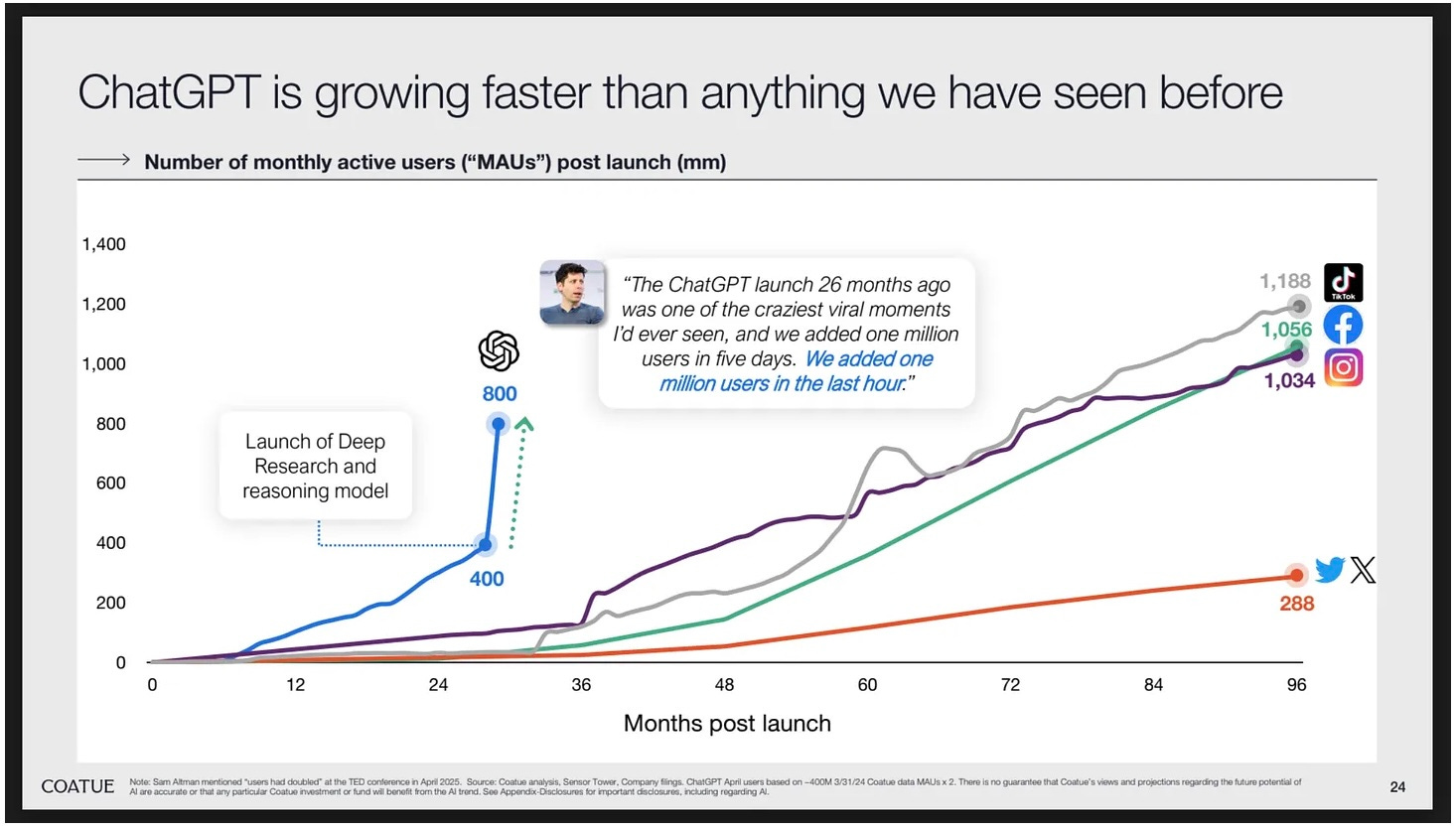
We all spent a lot more time using AI chatbots this year. The adoption rate of ChatGPT is unlike anything we’ve seen before.
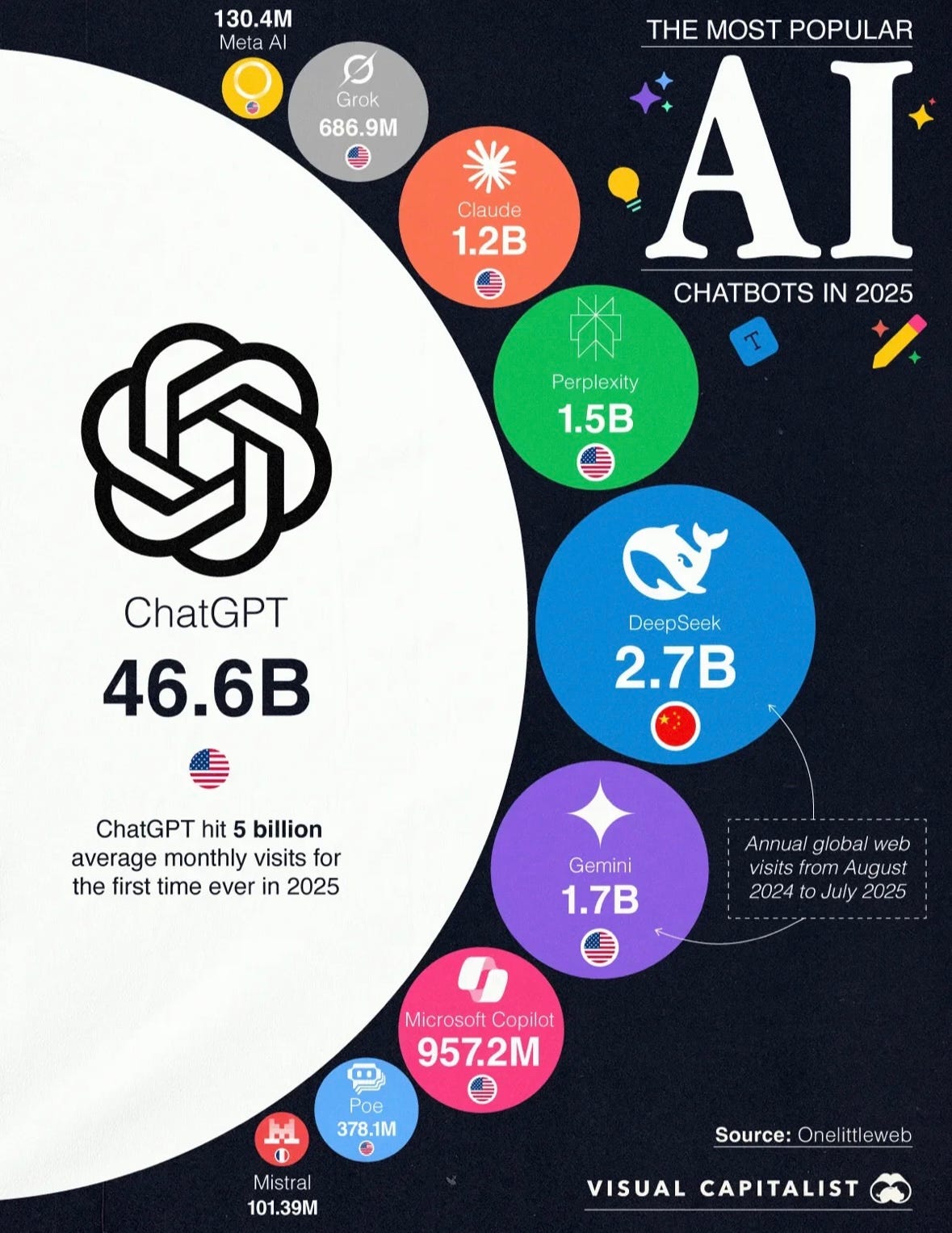
Of all the options, ChatGPT remains the reigning champ.
We don’t care if it makes us dumber! We don’t care if it flatters our worst ideas! We don’t care if it’s perverted! We love it anyways!
This X post demonstrates one of my concerns with chatbots:
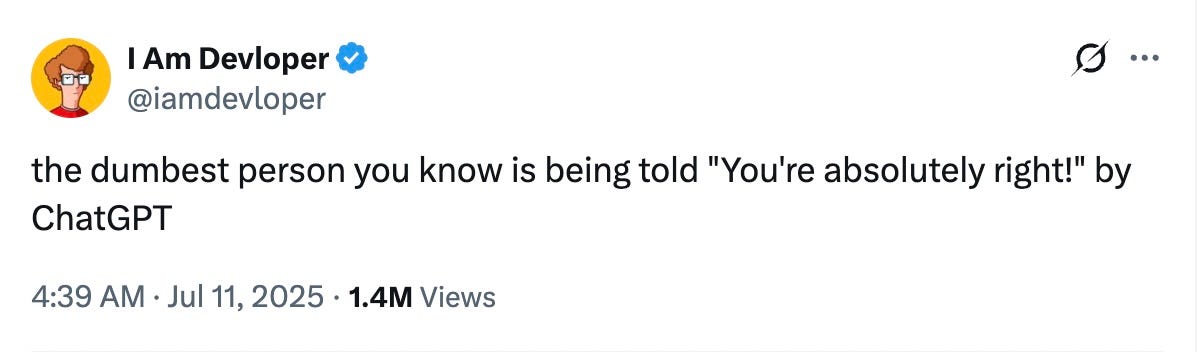
I’m hopeful that the sycophantic version of chatbots will be reigned in (maybe by regulation?) and that these tools will become better thought partners rather than flattery machines. Anthropic’s Claude already feels like a step in the right direction.
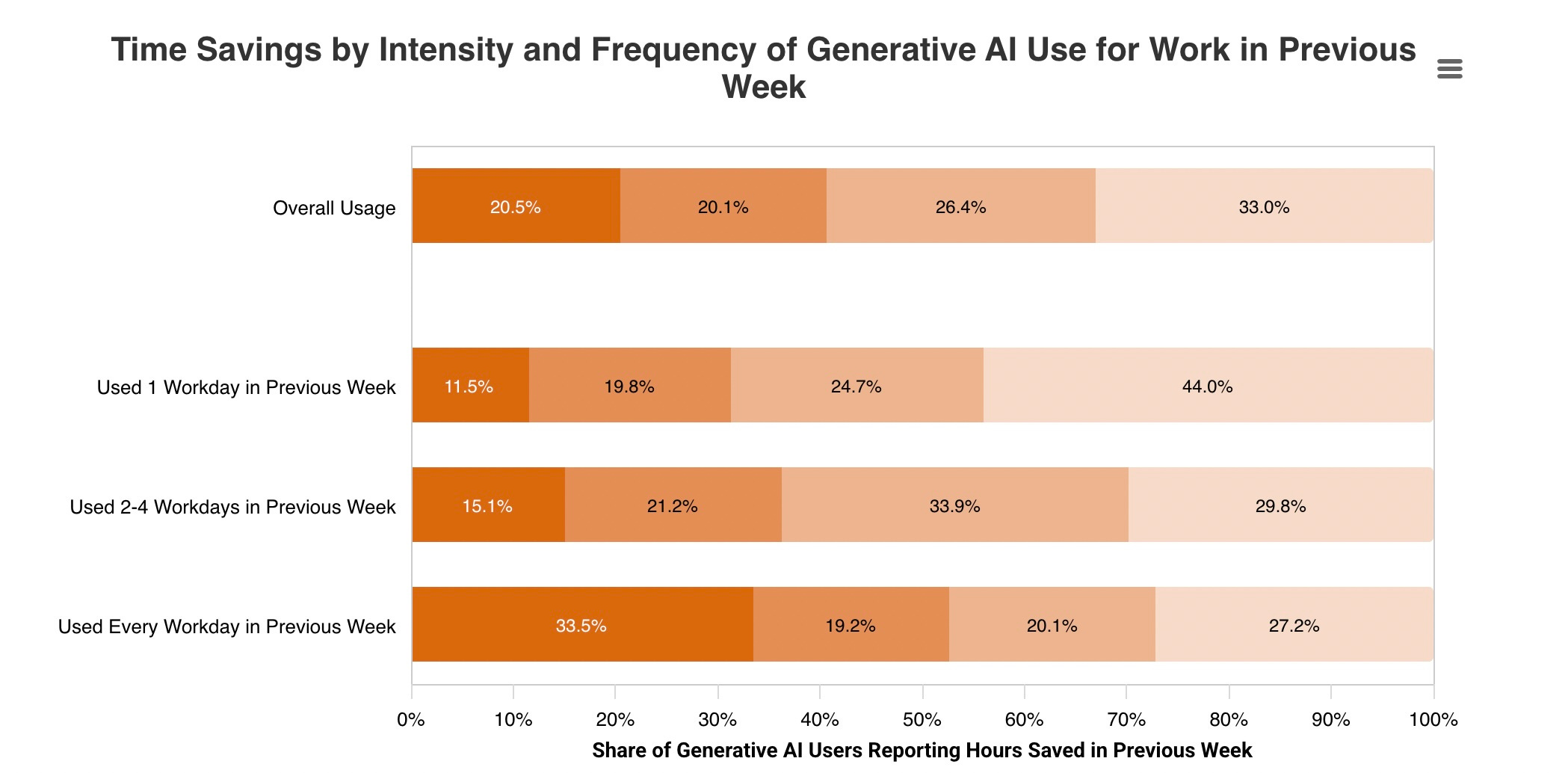
Aside from some very real issues, the technology itself is miraculous. In 2025, the productivity gains have been promising. The Federal Reserve analyzed data here:
Advances in disease treatment accelerated, and the possibilities for scientific discovery are staggering. Doris Tsao, a neuroscientist at UC Berkeley, told James Somers at The New Yorker:
“Neuroscientists have to confront this humbling truth: The advances in machine learning have taught us more about the essence of intelligence than anything that neuroscience has discovered in the past hundred years.”
It’s difficult to even comprehend how quickly AI is improving. Avital Balwit explains the growth in AI capabilities in The Digitalist Papers:
“In 2019, GPT-2 could barely count to five or string together coherent sentences. By 2023, GPT-4 was outperforming 90% of human test takers on medical licensing exams and the bar exam. In 2025, models are refactoring code bases for seven hours and winning gold at the International Mathematical Olympiad. Leading researchers at frontier AI companies increasingly believe we’ll achieve AI systems that can match or exceed human cognitive capabilities across virtually all domains before 2030.”
Balwit’s essay is ultimately about how young people should plan amid this uncertainty. Her best advice: Cultivate taste, values, relationships, trust, judgement, initiative, and vision. But read her whole piece. It’s good.
At conferences this year, I repeatedly heard predictions that physical work would become a refuge as AI transforms cognitive labor. Balwit dispels that idea, as does Jensen Huang in his GTC Paris Keynote. Physical work is not immune to disruption. AI will leave the cloud and enter the real world faster than most people expect.
The biggest concerns I heard this year center on job displacement and deep uncertainty about the future of work. CEOs talked about “junior extinction” — how to grow talent when entry-level work can already be done by machines. College students told me that they’re applying to 50 jobs without landing interviews. Parents of young kids tell me they aren’t sure if they should be saving for college.
All of these concerns are valid. New-grad unemployment is outpacing overall unemployment. Job candidates use AI to apply for jobs that are then evaluated by AI, pushing humans further out of the hiring loop. And none of us feel especially confident about how best to prepare kids for an uncertain future.
The growing pains of technological disruption can be painful, and sometimes destabilizing. But they are also periods of reinvention. I remind myself that societies often overestimate short-term disruption and underestimate long-term adaptability.
2026 will be another bumpy year as AI capabilities and usage continue to accelerate.
Leadership demands increased clarity
Speaking of uncertainty: Amazon, IBM, Omnicom, Nestle, Intel, Target, Paramount, UPS and others announced substantial layoffs this year.
The ground feels shaky and this has made managing people really hard. Return-to-office initiatives were hit-or-miss, and the fear around AI added to a broader sense of instability. Many leaders told me it’s difficult to get great work out of people when confusion and anxiety dominate the culture.
Harvard Business Review published a strong piece gathering reflections from leaders around the world. This one stayed with me:
“2025 changed the way I lead. It showed me that teams rarely struggle because the work is hard. They struggle because the ground underneath them keeps moving. I learned that leadership is less about giving direction and far more about giving people something steady to stand on. Clarity isn’t a message. Calm isn’t a personality trait. They’re conditions. And leaders create those conditions or they don’t. This year I paid closer attention to the moments before the work even begins—the energy people carry in, the questions they hesitate to ask, the pressure they hold quietly so they don’t slow anyone down. What changed wasn’t my strategy. What changed was the atmosphere I’m responsible for shaping. The biggest lesson of 2025: leadership is the feeling you leave in the room. People think better when that feeling is steady. They break when it isn’t. Going into 2026: Less rushing. More grounding. Less noise. More intention. And a commitment to giving people the stability they need to rise.”
—Jose, a healthcare professional in New Jersey
In a year defined by instability, leadership clarity mattered more than ever. Let’s bring that into 2026.
Millennials reevaluate intensive parenting
In one of my Gen Z focus groups this year, a young woman said she doesn’t think she wants kids because “millennials make parenting look like hell on earth.” (I try not to laugh in these sessions but this one got me. It’s so great. And kind of true).
Parenting is hard. And awesome. And it’s not the job of young parents to sell the experience to a new generation by pretending it’s easy.
Still, there’s no denying how parenting time has increased. Today’s working mothers spend as much time with their children as stay-at-home mothers spent with their children in 1975. Fathers are also spending much more time parenting their kids.
Jonathan Haidt released The Anxious Generation in 2024, but 2025 was when schools really began hosting book clubs and discussion around his ideas. While many readers focus on smartphones, a central argument in the book is about freedom: children are overprotected physically and under protected digitally.
In response, millennial parenting groups are forming in schools and communities to encourage more independence and less hovering. The movement is framed as being better for kids. But it’s also better for parents.
I suspect aspects of intensive parenting are here to stay. Many upper-middle-class families feel trapped in an arms race over their children’s futures. Parents see good jobs getting better, bad jobs getting worse, and middle jobs disappearing and that economic anxiety shapes how time and money are deployed.
Intensive parenting has also become a status signal for the striver class, which gives it staying power.
That said, physical freedom is clearly moving back into favor. And if that trend continues, it may soften parenting culture by providing some relief. Perhaps this kind of parenting will appear less “hellish” to Gen Z as they consider their own futures.
Ed Tech hits its reckoning
Five years ago, the incoming freshmen class at UC San Diego had 30 students with math skills below high-school level. Their incoming freshman class in 2025 had 900 students with below high-school level math skills. And most of those students don’t fully meet middle-school math standards. A large number of these students could not divide a fraction by 2. The full Senate report is here.
This is not just a UCSD issue. Universities across the country are reporting similar patterns.
I’ve already covered the NAEP scores so I won’t belabor the point. Suffice it to say: something is happening with students’ academic performance. (Even though most are still getting As. I’ll cover where grade inflation is at in January).
Academic underperformance is systemic and multifactorial, but one issue under renewed scrutiny is screen-based learning.
Jared Cooney Horvath released a book earlier the month titled, “The Digital Delusion: How Classroom Technology Harms our Kids’ Learning-and How to Help Them Thrive Again.”
An excerpt from The Free Press highlighted several striking findings:
After decades of rising IQ scores, Gen Z is the first generation to score lower than their parents on measures of literacy, numeracy, creativity, and general cognition.
More than 25% of students spend more than four hours on screens during a typical seven-hour school day. Researchers estimate that less than half of this time is spent learning, with students drifting off-task up to 38 minutes of every hour when on classroom devices
PISA data shows that students using computers more than six hours per day scored, on average, 65 points lower than peers who didn’t.
Even the SAT reflects this shift. Reading comprehension now means parsing 54 short snippets rather than grappling with extended passages. This is a fundamental change in how we define reading comprehension.
There’s compelling research on the benefits of analog learning, from handwriting to physical books.
I’m optimistic about where this leads. As with phones in schools, I don’t think anyone had ill intentions. I think technology moves fast, norms evolve quickly, and now we’ve reached a moment that demands recalibration.
Most school board members I speak with are not advocating for tech-free classrooms, just more intentional ones.
There are some promising new AI tools on the horizon that could help schools leverage tech in more effective ways. Google Research released a promo for a new tool designed to supplement traditional textbooks. Take a look here:

I see this reckoning as a correction, not a collapse.
Everyone is Romanticizing 2012
This year, Gen Z flocked to TikTok asking Millennials how they survived entering the workforce during the 2008 Recession. Millennials answered honestly: they were drunk.
They got drunk when Lehman Brothers collapsed and stayed that way for the next few years. By the time they sobered up, the economic recovery was in full swing and things were looking up. This ushered in what has become the “millennial optimism era.”
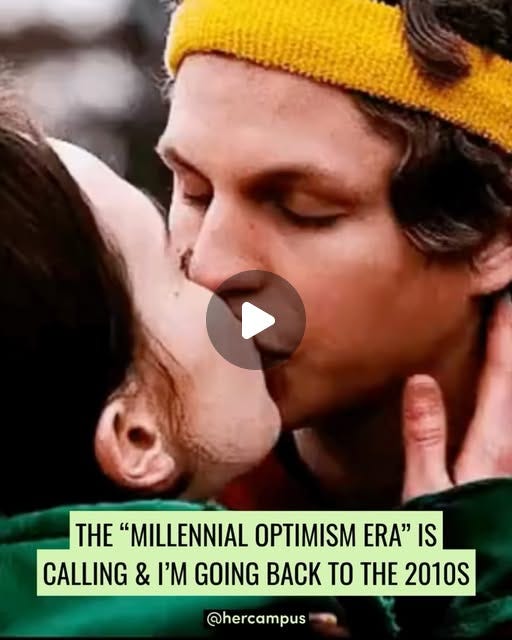
I try to keep myself out of the commentary but wow this era was genuinely great. VC money padded our lifestyles, shared economic hardship created a sense of community, and recession pop dominated the airwaves. What is recession pop? It’s the music Millennials danced to between the hours of 1am-6am when they were overeducated and underemployed. Think Akon, Taio Cruz, Rihanna, Usher, Kesha, Zedd, Swedish House Mafia, Calvin Harris, etc.
Here is an assortment of people reliving the glory of this musical era:


Alogrithm-free social media combined with the hope-and-change energy of the first Obama presidency produced a uniquely whimsical youth culture. We feel really far from an “optimistic Gen Z era” but time has a funny way of rewriting generational legacies.
If you told Millennials in 2008 that 2012 would be remembered as a golden age, no one would have believed you.
2025 was heavy
At the end of 2024, I predicted that 2025 would be a year of courage and optimism. I had my reasons for thinking this but I was wrong. That’s the nature of predictions— you’re either right or you’re embarrassed.
In focus groups, I sense fear and malaise. The inability to buy a home came up repeatedly, especially among Gen Z. I heard things like: “I’ll never buy a home, so I might as well…” followed by travel, invest, buy a pet, or spend.
Many of these participants were employed 22-to 25-year-olds who had already internalized a closed future.
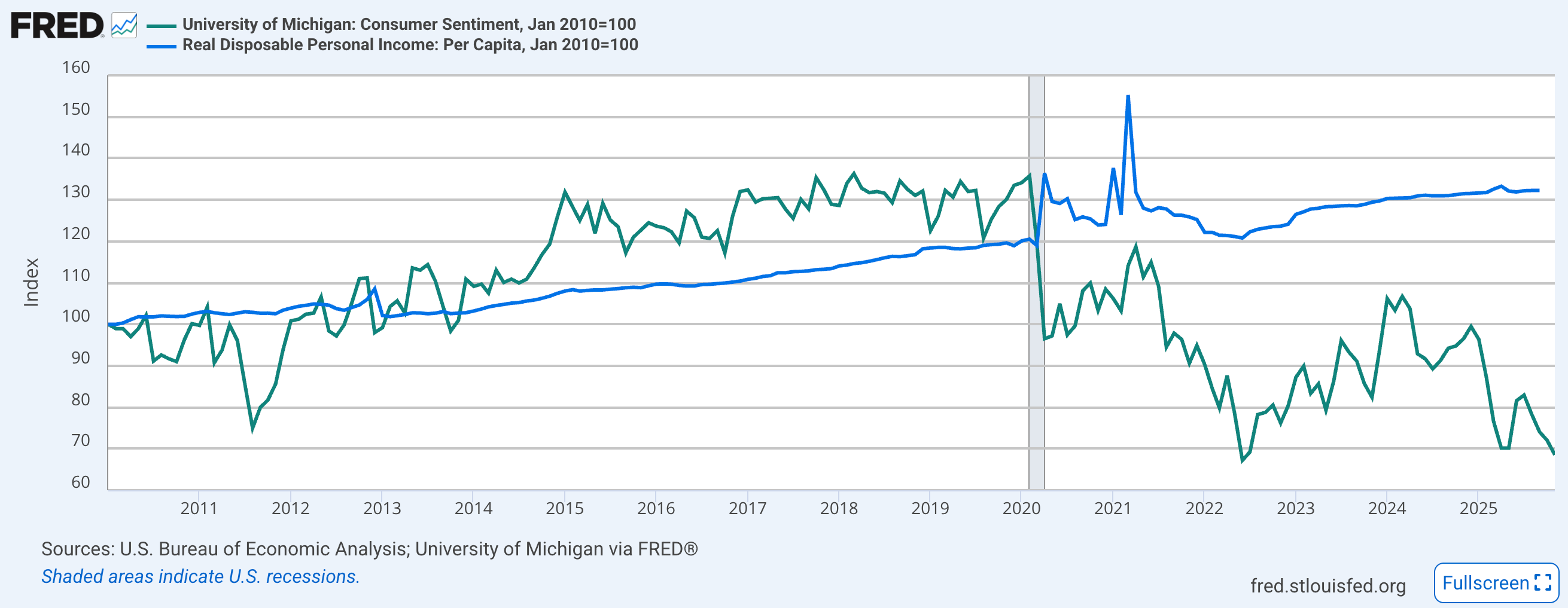
Perceptions of the future are not in great shape.
Real disposable income began to recover in the fall of 2020 but sentiment continued to plummet:
(Check out these essays by Paul Krugman, Scott Alexander , and Kyla Scanlon for more insight into the Vibecession)
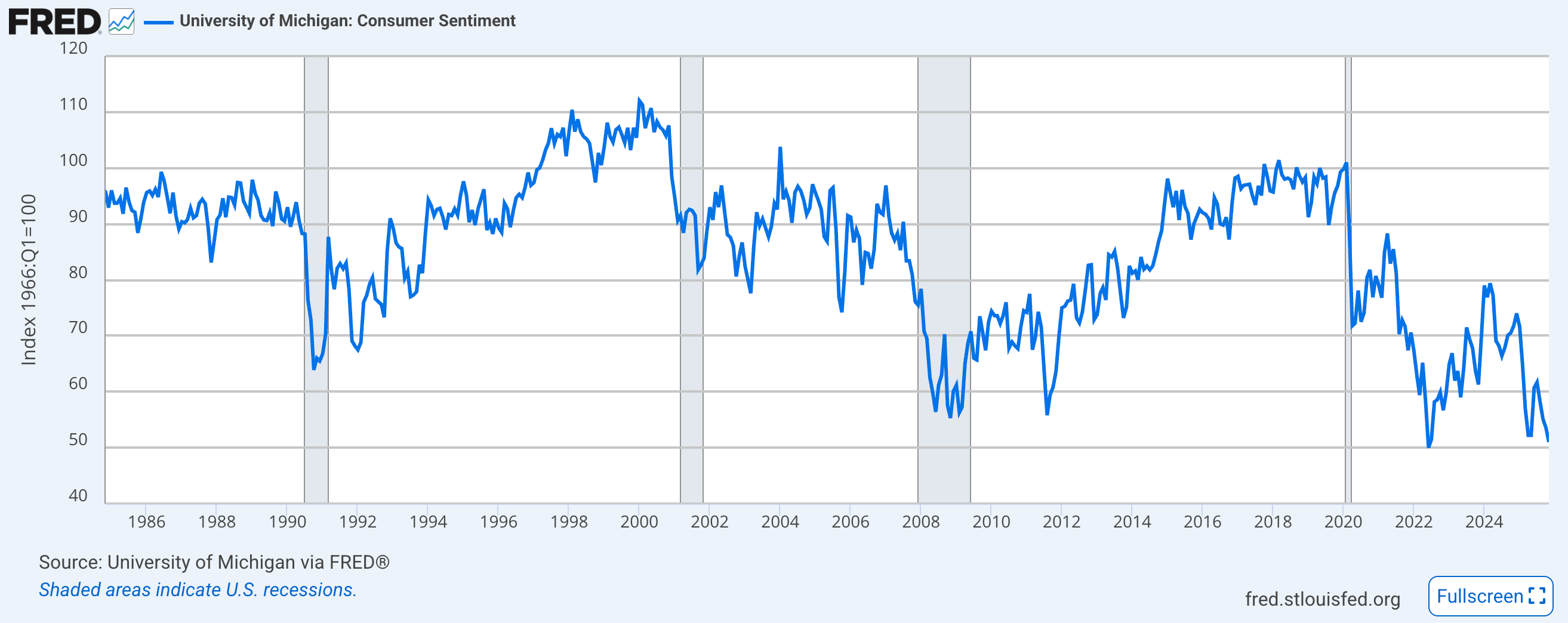
Consumer sentiment is at an all-time low:
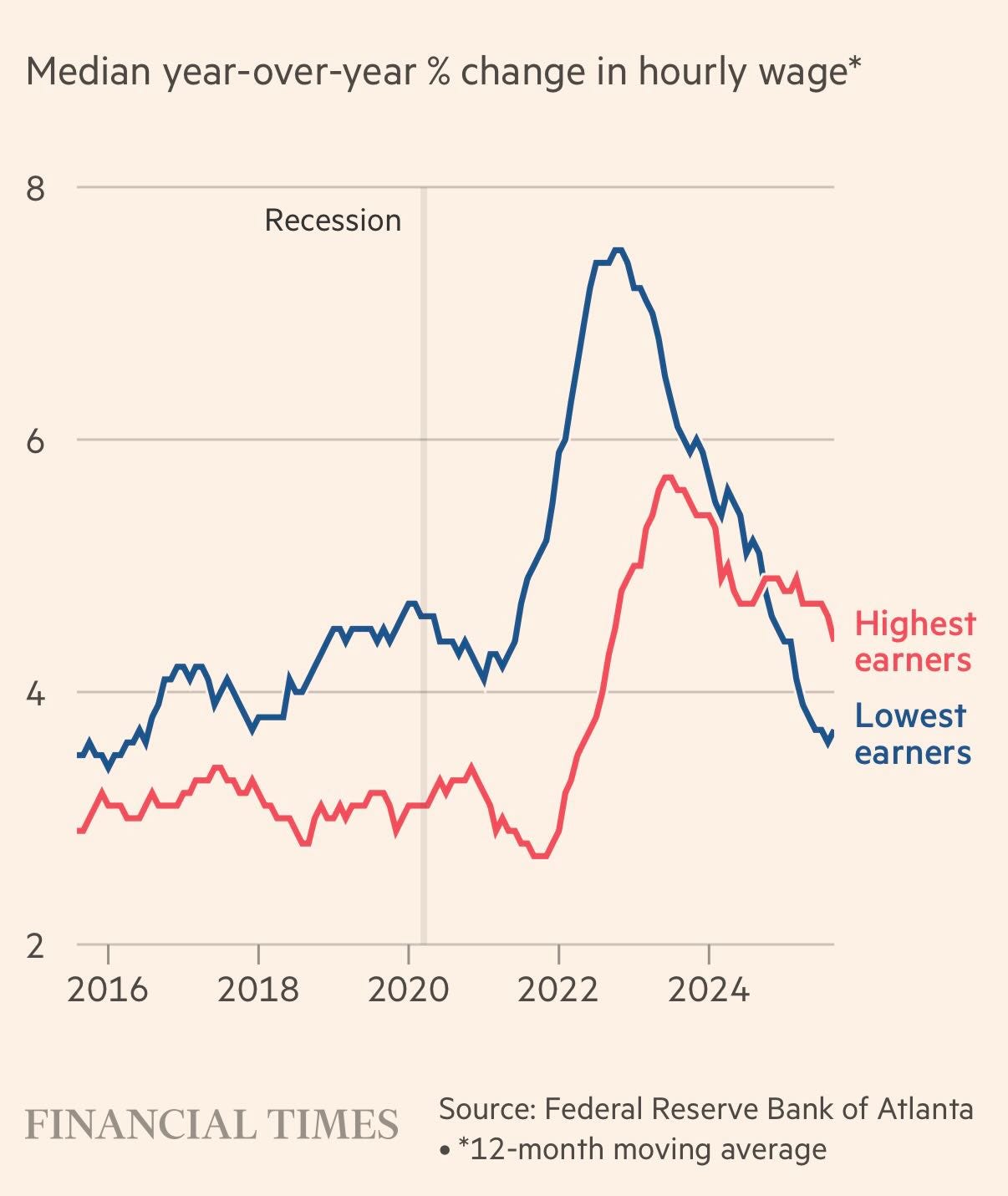
Inequality is worsening:
The Harvard Youth Poll shows a generation feeling left behind. Jordan Shwartz, the student chair of the Harvard Public Opinion Project said:
“Gen Z is headed down a path that could threaten the future stability of American democracy and society. This is a five-alarm fire, and we need to act now if we hope to restore young people’s faith in politics, America, and each other.”
None of this is something any one policy, election, or institution can fix overnight. But faith doesn’t usually return all at once anyway. It’s rebuilt in smaller, quieter ways—through mentorship, through showing up, through taking younger people seriously, and through modeling steadiness when the future feels uncertain. Restoring faith in one another isn’t abstract. It’s relational. And it’s something many of us are already doing, often without calling it that.
Work/Life
I delivered 60 keynotes this year, wrapped up year 2 of my Filene fellowship, completed year 5 of my Gen Z longitudinal study, and was fortunate to work with great interns over the summer. Thank you to all of my clients and collaborators. I am so grateful.
One of my 2025 goals was to party more and I succeeded! I hosted more parties, attended more parties, and spent more free time with people.
We went on a summer road trip through Jackson Hole, The Grand Tetons, Yellowstone National Park, and Big Sky. I can not recommend this trip enough. Our kids are 8 and 6 and those were perfect ages for a trip like this. Reach out to me if you want suggestions.
Things I liked
Therabody mask —I know this is expensive but I can not believe the difference it was made with my skin
Westman Atelier makeup (except lipstick. Always this Chanel for lipstick)
Sombr (I missed the skinny boy emo genre)
Life of a Showgirl
The 18-minute unhinged Zoom satirical promo for Marty Supreme
This Home Alone SNL skit
Breakneck by Dan Yang
Emil Wakim stand up comedy (get tickets if you can)
Monks in The Casino by Derek Thompson
The Decline of Deviance by Adam Mastroianni
I’ll leave you with something I found inspiring this year. I read Ina Garten’s memoir and it was so lovely. A quote that stuck with me:
“There’s a wonderful quote attributed to George Lucas: “We’re all living in cages with the door wide open.” That was me until I realized I had the power-and the responsibility- to set myself free. To step out of the cage of whatever I’d experienced in the past, to think for myself, and to believe in my choices.”
Wishing you all good things in 2026.
Huge "aha moments" for me! I love how you are able to temper serious issues with a calm reassurance that all is not lost. Beautifully scripted, as always.
Kim… what a beautiful telling of our past and what’s to come. Our future is knocking loudly at our door and it’s hard to ignore it. We need to be active participants in what’s to come.
As always, thank you for your wonderful words. I always learn so much! Paula