

The Generational Divide of AI Sentiment
At a wedding this summer, I overheard the father of the bride chatting with some of his daughter’s friends. He was telling them about Anna, his AI chatbot. He named her that, and apparently she is incredible. He had prided himself on being a great email writer, but now Anna even makes his writing better and easier. He told the group that Anna knows everything about him and helps him sort through a whole host of work and personal issues. The young wedding guests nodded along but didn’t say much.
A few weeks after eavesdropping on this conversation, I was in Las Vegas for an event with the college leaders of Kappa Alpha Theta sorority. I stayed up until midnight (be impressed) chatting with a group of young women and many of them talked about how much their grandparents were using AI. They shared hilarious AI-generated images and messages from grandpa. The group seemed bewildered by grandpa’s enthusiasm.
Maybe we shouldn’t be that surprised. The screen time of retirees is a heavily covered topic. I work with a lot of financial services companies, and advisors often tell me about clients who work so hard to retire, and then, when they hit the milestone, they mostly watch TV. Back in 2019, Pew found that people over 60 were spending more than half their leisure time, over four hours a day, in front of screens. Chatbots may be a different animal, but the screens were already in place.
The older people who use AI seem genuinely delighted. And even though young people are the heaviest users, they are much more cautious and worried.
I have ideas about why this gap exists.
Why Older People Are Delighted
1. My initial hunch is ageism. Anti-tech often translates to anti-progress, and anti-progress translates to irrelevant. Even if it’s subconscious, I think many older people worry that if they express concern about new technologies, they’ll seem out of touch. And they’re right to worry. I remember the generational friction around social media when it first came out in the 2000s. Young people (me) were super excited while older people were confused about the utility of it, and they got treated like dinosaurs for thinking Facebook was dumb. Turns out, it is kind of dumb! They were kind of right! (Now Boomers love Facebook. A story for another time.) But I do think the fear of seeming old is part of what makes older people so enthusiastic about AI.
2. Another reason is the loneliness epidemic. The conversational tone of chatbots is impressive, and I think people who experience loneliness really connect with AI companions. Ipsit Vahia, chief of geriatric psychiatry at Mass General Brigham’s McLean Hospital and director of its Technology and Aging Laboratory, said in an Atlantic interview:
“High technology use in teenagers and adolescents is often associated with worse mental health and is a predictor of more isolation and loneliness, even depression. Whereas in older adults, engaging in technology seems to be protecting them from isolation and loneliness.”
Vahia points to pro-social tech behavior like Words With Friends, chats on Zoom, and text messaging. But the anecdotal picture I get from concerned kids and grandkids is about Instagram Reel spirals and conversations with flattering chatbots rather than people. Still, if the option is isolation or AI companionship, I can understand how companionship of any kind could create better outcomes.
The strange part is that young people use AI this way more than older people do. Pew found that one in five adults under 30 turn to chatbots for emotional support or advice, compared with 2% of those 65 and older. But in my focus groups, young people describe it with a kind of embarrassment. They use it, and they find it a little sad that they do. Older people describe the same behavior with delight. The father of the bride is a perfect example. He loved talking about Anna. Same tool, same function, different emotional register.
3. Chatbots are personal and patient. While there are endless ways to embarrass yourself publicly on social media, conversations with chatbots are private, so new users can take all the time they need to ask more questions and get helpful answers. The tone is flattering and the chatbot is never annoyed by the user, unlike children when their parents ask for tech help.
4. For anyone struggling with cognition, chatbots are genuinely amazing. I’ve talked with people who have a lot to share but they forget their words or find the mental effort of sorting it all out exhausting. Chatbots can fill in the gaps that come with any level of cognitive decline.
Why Younger People Are Wary
I want to be clear that Gen Z is using AI a lot.
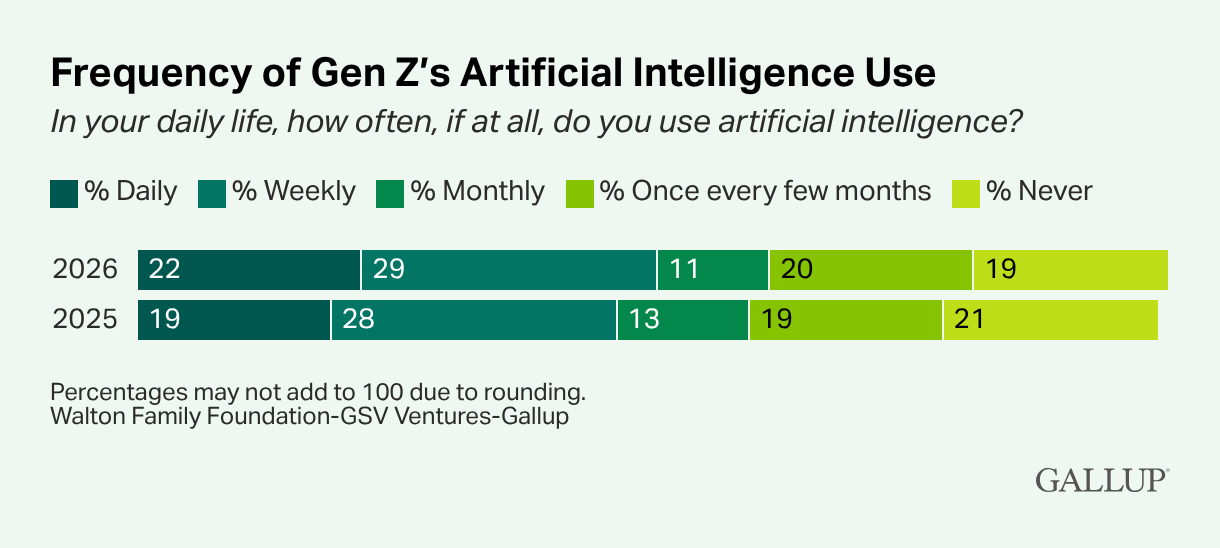
But their sentiment has worsened over the past year.
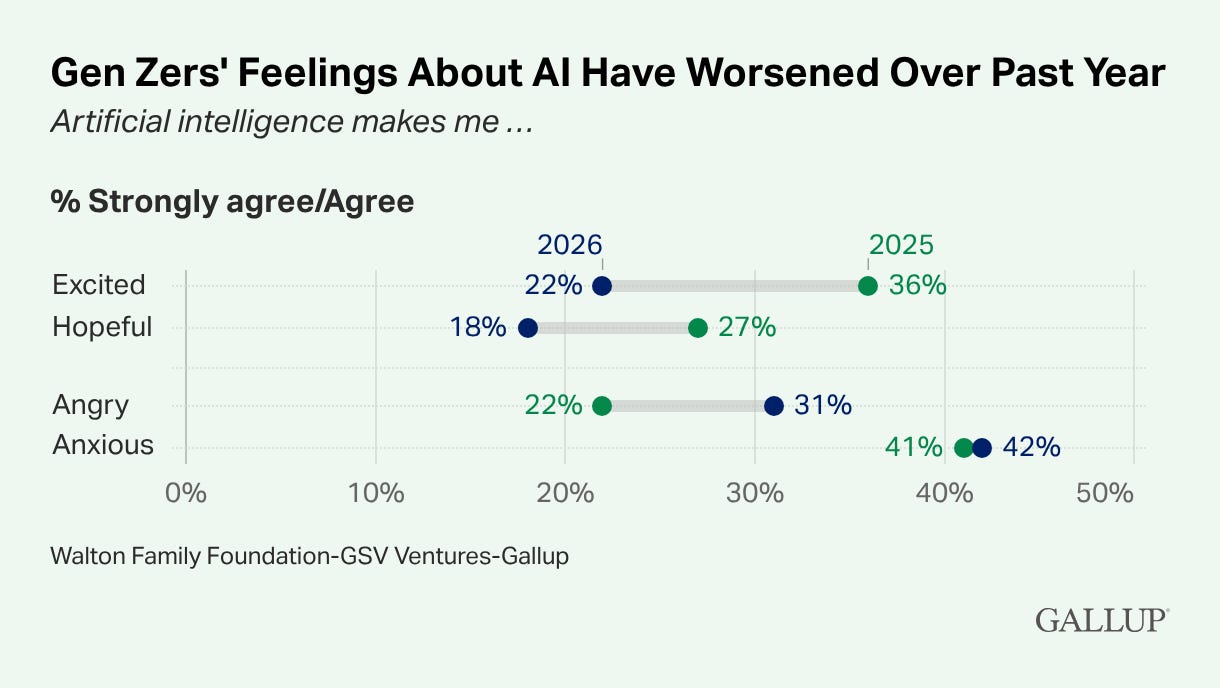
Two things I’m not going into here: environmental concerns and data center politics. Both issues matter a lot to Gen Z but they’ve been covered extensively and better elsewhere. (I recommend this essay from MIT Tech Review and this essay from Bloomberg)
I’m going to focus on a few other reasons to help explain why sentiment is going down:
1. For young people, part of the concern is also about cognition. It’s about holding on to it so they don’t need AI to remember their words when they age. Older adults have already built their cognitive capital, so offloading costs them little and may even compensate for a decline that has already started. Young people are still building their capabilities, so offloading may mean they never acquire the skill at all.
Cognitive surrender, cognitive atrophy, and mental offloading are now part of Gen Z vernacular. Young people say things to me like, “I can feel myself getting dumber after using AI too much.”
2. Gen Z is very good at clocking when something was written by AI, and they don’t like it. I thought a lot about why AI-dominant writing feels like such an assault, and I think it’s because there’s something supremely disrespectful about being asked to spend more time reading something than the writer spent writing it. Time is still scarce, and reading and digesting remain time consuming. I’ve seen this in my own life. People send me material, and if I sense it was written by AI, even if it’s good, I’m so offended that I delete it immediately. The time asymmetry is the problem. I don’t think anyone likes reading work that’s primarily AI-generated, but young people identify it faster and seem to judge it more harshly.
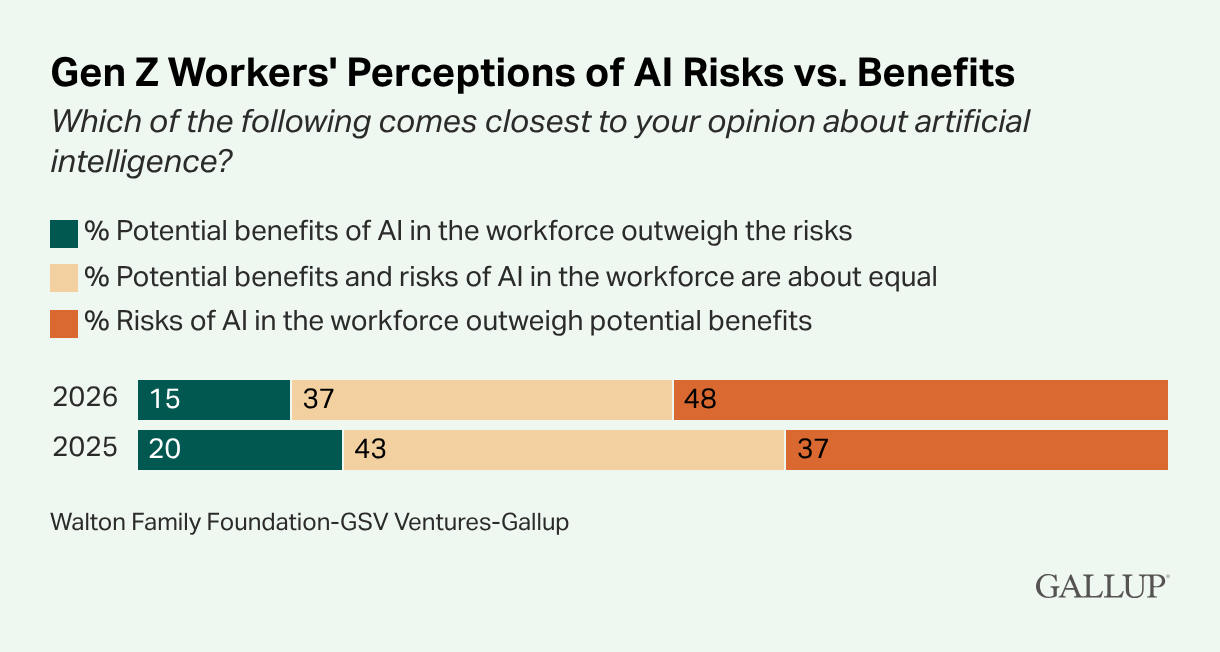
3. The most obvious reason for a generational divide about AI is jobs. Retirees aren’t competing with AI for work. Young people are. As the Gallup chart above shows, an increasing number of Gen Zers say the risks of AI outweigh the benefits, and job displacement is one of the big risks.
4. And then, of course, there’s the recent conversation about AI killing us all. In case you missed it, Jacob Coxon, a pretraining researcher, announced his resignation from Anthropic on X. Among his reasons for leaving was this gem:
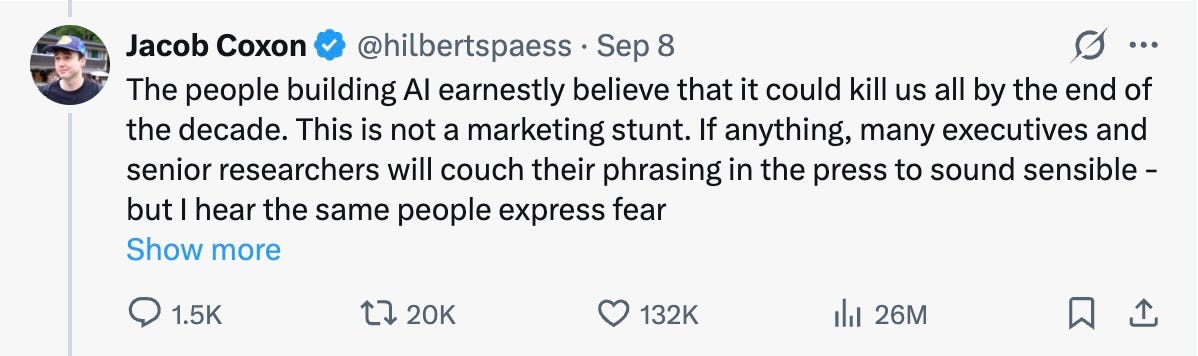
Days later, Anthropic CEO Dario Amodei published “We Must Pace the Frontier” on his personal site, arguing that the industry needs to slow the rate at which it improves AI capabilities so that safety work can catch up. Sam Altman and Elon Musk both tweeted their agreement.
I hear far more concern about this doomsday scenario from younger people than older people. Older people have a lot of examples of doomsday predictions that never happened, so maybe part of it is a rightful disbelief that this time is different. But for many young people, this is their first time living through massive tech disruption, and the truth is, we don’t know. And the people in charge seem freaked out. On one hand, I understand the skepticism toward doomsday predictions. On the other, I am kind of scared.
The Stakes Define the Sentiment
How people feel about AI is largely shaped by what’s at stake for them. For most older users, the experience has been overwhelmingly positive. Companionship, cognitive assistance, and patience are immediately useful. And having lived through a parade of doomsday predictions that never arrived, many of them have little reason to think this one is different.
For young people, the same technology comes loaded. It’s powerful, useful, and full of promise, but it might take their jobs, erode their thinking, and end the world. The years ahead belong to them which means the upsides and the risks land harder. (Although I guess ending the world would impact us all equally. Finally, something we have in common!).
The generational divide about AI is not about tech savviness or optimism. The divide is about the stakes. What do you have to gain or lose from this technology? Everyone’s sentiment about AI turns out to be a reasonably accurate reading of their own position.
If you find yourself baffled by someone’s view or use of AI, figure out what they have riding on it. That answer can help you better understand where they’re coming from and what they might gain or lose as this technology accelerates.
My recent interviews
Why Canadian Salaries Have Stopped Making Sense, Ali Amad at The Peak
Ali interviewed me about how young people feel about the future. We cover a lot of economic topics but I also focus on how pessimism becomes a self fulfilling prophecy. I’ve heard high-earning young people repeat disillusioned social media talking points such as: I’ll never be able to buy a house, nothing works, everything is working against me. And I have seen how bad outcomes seem to become true for those most bought into this narrative. This doesn’t mean that headwinds don’t exist, but buying into a stream of negative affirmations has a bigger impact on outcomes than I would have expected.
The Industrialization of Temptation, Sara Wilson at Community Catalyst
Sports betting, online gambling, the 24/7 mall, and a very sophisticated advertising landscape have created the ideal conditions to separate people from their money. Sara and I talk about what this means for brands and for young people as they try to find their financial footing.
Upcoming speeches
Coming up I’m speaking in Dallas, Washington DC, New Orleans, Savannah, Denver, Madison, Boston, New York, Kansas City, and Minneapolis. Can’t wait to see some of you soon.
Things I’m Loving
“Use Your Brain: Think Deeper in a World on Autopilot” by Erica Dhawan is open for pre-orders
The book is about work, creativity, intuition, parenting, and how to keep our human spark alive in the age of machines. Erica is the best storyteller. Can’t wait for this one.
Derek Thompson podcast about The Mississippi Miracle
Thompson interviews Rachel Cantor, a Mississippi education reformer, about how Mississippi went from the second most illiterate state in the country to the 9th most literate in the span of 13 years. She talks about navigating bureaucracy, the struggles with teacher’s unions and higher education, the science of reading, and above all, the stamina required to create real change. Cantor wants to rename Mississippi’s achievements from “The Mississippi Miracle” to “The Mississippi Marathon.” The educational achievements weren’t a miraculous gift from above, they were a result of dedicated people working tirelessly to create better outcomes for kids.
This unhinged trailer for the new documentary about Elizabeth Holmes
I will never get over Theranos. This is my lifelong obsession.
Olivia Dean and Leon Bridges singing The Hardest Part
Stunning. Perfection.
Dab it on with your fingers instead of using a makeup brush or beauty blender. I like the shade Flushed.
Thank you for reading!!